Implant-Supported Dental Bridge
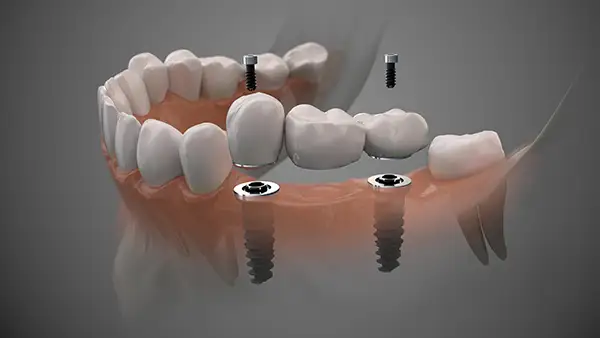 An implant-supported dental bridge in Manchester, CT at Columbia Implant Center replaces several missing teeth in a row with a fixed bridge held by dental implants. Instead of using nearby natural teeth as anchors, the bridge connects to implants placed in the jaw. That can make the replacement feel more stable and protect healthy neighboring teeth from unnecessary reshaping. An implant-supported dental bridge in Manchester, CT at Columbia Implant Center replaces several missing teeth in a row with a fixed bridge held by dental implants. Instead of using nearby natural teeth as anchors, the bridge connects to implants placed in the jaw. That can make the replacement feel more stable and protect healthy neighboring teeth from unnecessary reshaping.
This page focuses on implant-supported bridges. Our main Dental Implants page explains implant treatment more broadly, while this guide explains how implants can support a bridge when multiple teeth are missing in the same area.
At our Manchester center, implant bridge planning can involve the surgical team, restorative team, and in-house digital lab from the beginning. That matters because the implant positions, bridge shape, bite, and gum support all need to match before the final teeth are made.
On This Page
What an Implant-Supported Dental Bridge Is
An implant-supported dental bridge is a fixed restoration that replaces a span of missing teeth. The bridge is attached to dental implants rather than bonded to natural teeth on either side of the gap. For many patients, that is the main advantage.
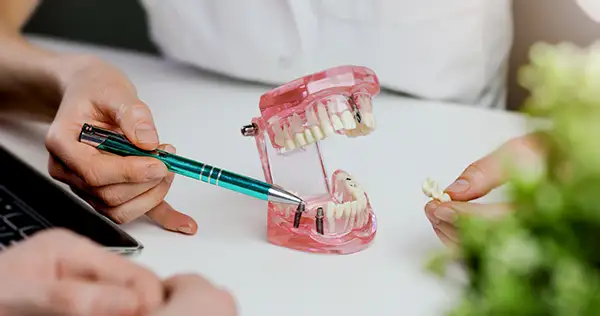 A traditional bridge usually requires reshaping the teeth next to the empty space. An implant-supported bridge can avoid that step because the implants carry the bridge. This is often useful when the neighboring teeth are healthy, or when the missing-tooth span is too long for a traditional bridge to support predictably. A traditional bridge usually requires reshaping the teeth next to the empty space. An implant-supported bridge can avoid that step because the implants carry the bridge. This is often useful when the neighboring teeth are healthy, or when the missing-tooth span is too long for a traditional bridge to support predictably.
Most implant bridges use two or more implants, though the exact number depends on the length of the gap, the strength of your jawbone, your bite, and the type of bridge being made. If you are missing several teeth in a row, our Replacing Multiple Teeth page gives a broader look at your replacement options.
When this option makes sense
An implant bridge may be a good fit if you have three or more missing teeth in one area, a removable partial denture that feels loose, or failing teeth that need to come out in the same section of the mouth. It can also be a strong option when you want a fixed replacement but do not need a full arch restoration.
When another option may be better
If only one tooth is missing, a single tooth implant may be more appropriate. If most or all teeth in an arch are missing or failing, full arch dental implants or All-on-4 treatment may fit the problem better than a bridge.
Your Implant Bridge Team in Manchester
 Dr. Abbas Mohammadi, DDS, is the clinical director of Columbia Implant Center in Manchester. His clinical director bio notes 27 years of dental experience, a DDS from Columbia University, and a postdoctoral fellowship in periodontology, oral microbiology, and molecular biology. Dr. Abbas Mohammadi, DDS, is the clinical director of Columbia Implant Center in Manchester. His clinical director bio notes 27 years of dental experience, a DDS from Columbia University, and a postdoctoral fellowship in periodontology, oral microbiology, and molecular biology.
That background matters for implant-supported bridges because the treatment sits at the intersection of bone, gums, bite pressure, and prosthetic design. An implant bridge has to be strong enough for chewing, shaped well enough to clean, and positioned so the implants are not overloaded.
Columbia Implant Center uses a multispecialty model in one Manchester location. The practice includes prosthodontics, oral and maxillofacial surgery, periodontics, endodontics, orthodontics, and general dentistry. For an implant bridge case, that means the team can evaluate surgical placement, gum health, bite design, and the final restoration without sending each step to a separate office.
The in-house digital lab also plays a practical role. The lab includes milling machines, intraoral scanners, and 3D printers, and it supports crowns, bridges, dentures, surgical guides, and implant-related restorations. For an implant bridge, the clinical team and lab can work from the same digital records when checking fit, shape, and bite.
The Implant-Supported Bridge Process
1. Exam, scan, and bite review
Your first visit includes an exam, medical and dental history review, and digital records. Intraoral scanning at our Manchester center gives the clinical team and in-house lab a shared view of the missing-tooth area, the bite, and the space available for the bridge.
2. Implant and bridge planning
The team plans where the implants should go and what the bridge needs to do. This step is not only surgical. Our restorative team and lab also look at the tooth shape, bite contacts, and cleaning access before treatment begins.
3. Tooth removal or grafting if needed
If failing teeth are still present, treatment may include tooth extractions for implants. If the jawbone is too thin or weak in the bridge area, bone grafting for dental implants may be recommended before or during implant treatment.
4. Implant placement and healing
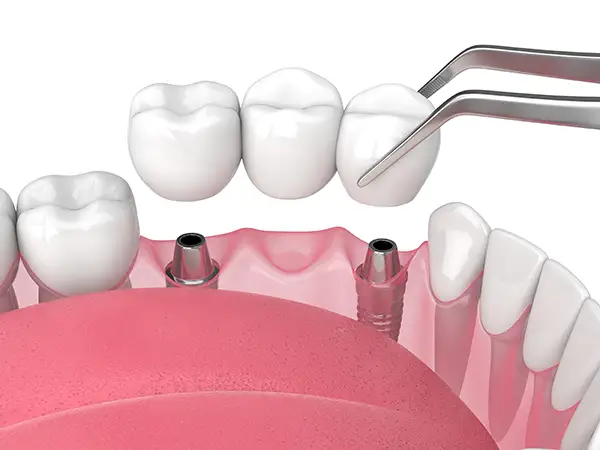 When implants are placed, we keep the treatment area numb and check your comfort throughout the visit. The implants then need time to heal in the jaw before the final bridge is attached. This healing phase often takes several months because the bone must bond with the implant surfaces. When implants are placed, we keep the treatment area numb and check your comfort throughout the visit. The implants then need time to heal in the jaw before the final bridge is attached. This healing phase often takes several months because the bone must bond with the implant surfaces.
5. Temporary and final bridge
A temporary tooth replacement may be possible while the implants heal, depending on your case. Once the implants are ready, our in-house lab and clinical team can refine the final bridge against the original digital plan so the fit, bite, and tooth shape are checked together.
Benefits of an Implant-Supported Dental Bridge
An implant-supported dental bridge is designed for patients who want a fixed solution for multiple missing teeth without turning nearby healthy teeth into bridge anchors. At Columbia Implant Center, the plan is built around the implant positions, bridge design, gum support, and bite forces together.
Protects neighboring teeth
A traditional bridge often requires reducing the teeth on each side of the gap. An implant-supported bridge uses implants for support, so healthy adjacent teeth may not need to be reshaped. That can be a major advantage when those teeth are strong and do not need crowns.
Feels more stable than a removable partial
A removable partial denture can move during meals or speech. An implant bridge stays fixed to implant abutments, so the goal is a more secure chewing experience. Patients still need time to adapt, but they do not remove the bridge at night like a partial denture.
Uses the jawbone for support
Dental implants transfer chewing forces into the jawbone. That support helps the bridge function more like natural teeth than a removable appliance resting on the gums. The exact chewing strength depends on bone quality, implant placement, and the final bridge design.
Can be planned with lab input early
Because our Manchester center has an in-house digital lab, the bridge is not an afterthought once surgery is finished. The lab can help the team think through tooth size, implant spacing, bridge contours, and bite contacts before the final restoration is made.
Why Choose Our Team for an Implant Bridge
Implant-supported bridges require a careful match between surgery and restoration. If the implants are placed without enough attention to the final bridge, the teeth can be harder to clean, harder to adjust, or less comfortable when you chew. Columbia Implant Center plans implant bridge cases with the final restoration in mind.
Our in-house digital lab was added in 2020 and includes milling machines, intraoral scanners, and 3D printers. For an implant bridge patient, that means digital impressions, bridge design, models, guides, and adjustments can be handled with closer communication between the lab and the clinical team.
The Manchester office is open seven days a week, 365 days a year, and provides care across 22 languages. Implant bridge treatment can involve several visits, especially if teeth need to be removed, bone needs to heal, or a temporary bridge needs an adjustment. More available access helps patients keep treatment moving.
| • |
Implant and bridge planning together - The team considers implant position, tooth shape, bite pressure, and cleaning access before the final bridge is made.
|
| • |
In-house lab support - The Manchester lab can support digital scans, 3D printed models, surgical guides, temporary restorations, and final bridge planning.
|
| • |
Multi-specialty care in one center - Prosthodontics, oral and maxillofacial surgery, periodontics, and general dentistry can be involved when the case needs more than a basic restoration.
|
| • |
Seven-day availability - Staged implant treatment is easier to manage when the office has broader access than a traditional weekday schedule. |
The In-House Dental Lab page explains how the lab supports crowns, bridges, dentures, implants, surgical guides, and other restorations made from digital records.
Implant Bridge Cost and Financing
The cost of an implant-supported bridge depends on the number of missing teeth, how many implants are needed, whether extractions or grafting are part of the plan, and what materials are used for the final bridge. A short bridge in one area is different from a long-span bridge replacing several back teeth.
The Financial and Insurance page explains how insurance information, benefit estimates, co-payments, discount programs, and payment systems are handled for qualifying patients. Dental or medical insurance may help with certain parts of treatment, but coverage varies by plan.
For a personalized estimate, call (860) 743-1898 or use our Request an Appointment page to schedule a consultation. Our front office team can review your information and explain the financial policy before treatment begins.
Schedule an Implant Bridge Consultation
Call (860) 743-1898 or use our Request an Appointment page to schedule. We are at 483 Middle Turnpike W in Manchester, CT 06040.
You can also reach us through our Contact page with questions before booking.
Frequently Asked Questions
How many teeth can an implant-supported bridge replace?
An implant-supported bridge commonly replaces several missing teeth in a row. The exact span depends on your bone, bite, implant positions, and the material used for the bridge. At our Manchester center, we plan the bridge from the final tooth design backward so the implants support the restoration properly.
Is an implant bridge better than a traditional bridge?
An implant bridge may be better when the teeth next to the gap are healthy and do not need crowns. A traditional bridge can still make sense in some cases, but it usually requires reshaping neighboring teeth. An implant bridge uses implants as the anchors instead.
Is an implant bridge removable?
Most implant-supported bridges are fixed in place and are not removed by the patient. Your dental team can remove the bridge if repairs or maintenance are needed. If you want a removable option, implant-anchored dentures may be worth comparing during the consultation.
Will I need bone grafting before an implant bridge?
Some patients need bone grafting for dental implants before an implant bridge, especially if the teeth have been missing for a long time or infection damaged the bone. A scan gives us a clearer answer than a visual exam alone. If grafting is needed, we explain how it changes the timeline.
Can I get an implant bridge the same day?
A same-day temporary bridge may be possible in selected cases, but the final implant bridge usually comes later. The implants need time to heal and bond with the jawbone first. Our In-House Dental Lab page explains how the lab supports temporary and final restorations when the case allows.
How do I clean under an implant-supported bridge?
You clean under an implant bridge with tools such as floss threaders, interdental brushes, or a water flosser, depending on the shape of the bridge. We show you the specific technique once the bridge is in place. Cleanable contours are part of the design conversation before the bridge is made.
How long does implant bridge treatment take?
Implant bridge treatment often takes several months because the implants need time to heal before the final bridge is attached. Cases with extractions, grafting, or a temporary bridge can take longer. Our seven-day Manchester schedule can help keep the staged visits easier to manage.
How much does an implant-supported dental bridge cost?
The cost depends on the number of teeth being replaced, the number of implants needed, whether grafting or extractions are part of the plan, and the final bridge material. After your exam and scans, our team can give you a personalized estimate and review insurance or payment options. |